
Tesla Autopilot and AI: A Deep Dive into Autopilot, FSD, and Vision-Based Autonomy
By Hamza Khalid, Tesla, Inc.
Tesla Autopilot and Full Self-Driving (Supervised) combine advanced driver assistance with a sophisticated AI framework—featuring Tesla Vision and Dojo—to enable camera-centric perception and continuous learning. This guide explains Autopilot, details how FSD enhances baseline features, outlines the perception and training architecture, and discusses the regulatory and safety landscape. It covers core functions like Traffic-Aware Cruise Control and Autosteer, FSD capabilities such as Navigate on Autopilot and Traffic Light/Stop Sign Control, and Tesla’s use of neural networks trained on billions of miles of anonymized driving data. The guide also touches on Over-the-Air updates, FSD subscription options, and the in-vehicle experience presented on the Autopilot interface. Readers will gain a clear understanding of SAE Level 2 limitations, how the AI stack drives incremental improvements, and the product choices available to owners.
This comprehensive overview sets the stage for understanding Tesla’s evolving driver assistance ecosystem. It highlights the blend of technology, safety considerations, and user experience that define the Autopilot and FSD systems.
Key Takeaways
- Tesla Autopilot is a Level 2 driver-assistance system that always requires active driver supervision.
- Full Self-Driving (FSD) builds upon Autopilot, adding advanced features for both highway and urban driving, still under driver supervision.
- Tesla Vision is a camera-based perception system that uses neural networks to understand the vehicle’s surroundings and control its movement.
- The Dojo supercomputer is dedicated to accelerating the training of neural networks, leveraging billions of miles of anonymized driving data from Tesla vehicles.
- Over-the-Air updates allow Tesla to deliver continuous improvements and new features directly to vehicles, eliminating the need for physical service.
- FSD can be accessed through a one-time purchase or a subscription, offering flexibility in how owners access enhanced autonomous features.
- SAE Level 2 automation requires constant driver engagement, differentiating Tesla’s current systems from higher levels of autonomous driving.
- Current safety regulations and approval processes limit the widespread deployment of Level 3 and higher autonomous driving technologies.
- The in-car Autopilot interface provides real-time visual feedback and alerts to help drivers stay aware and maintain supervision.
This summary crystallizes the essential aspects of Tesla’s Autopilot and FSD technologies. It underscores driver responsibility, technological innovation, and evolving regulatory contexts.
What is Tesla Autopilot? Features, SAE Level 2, and Safety
Tesla Autopilot is a sophisticated driver-assistance system (ADAS) offering Level 2 automation. It utilizes camera-based perception and neural networks to support the driver. The system integrates vehicle computing power and sensor data to manage speed, follow traffic, and stay within its lane, always requiring the driver to remain attentive and ready to take control. Its primary safety benefit lies in reducing the monotony of routine driving and enabling continuous improvements through fleet learning delivered via software updates. Understanding these fundamental capabilities helps owners set realistic expectations and consider upgrades to Full Self-Driving (Supervised), which introduces more advanced driving functionalities.
The Autopilot system enhances driver convenience but is designed explicitly to keep the human driver engaged. Tesla encourages owners to view Autopilot as an assistive tool, not a replacement for active driving.
Tesla Autopilot includes these core driving assists:
- Traffic-Aware Cruise Control: Automatically adjusts speed to maintain a safe distance from vehicles ahead and matches the flow of traffic.
- Autosteer: Assists with lane centering and steering, helping to keep the vehicle within its lane markings while the driver supervises.
- Driver Supervision Requirement: All Autopilot features necessitate that the driver remains actively engaged, observant, and prepared to intervene at any moment.
These features collectively aim to ease driving while emphasizing the indispensable role of the driver. Safety is ensured through continuous supervision and readiness to override the system.
The table below outlines Autopilot features, their primary functions, and important notes regarding supervision.
This breakdown clarifies how each Autopilot component contributes to safety and reinforces the Level 2 supervision model, which mandates active human oversight.
Understanding specific capabilities and their limitations fosters safer use and realistic expectations regarding Autopilot’s role.
Core Autopilot Features: Traffic-Aware Cruise Control and Autosteer
Traffic-Aware Cruise Control and Autosteer work in tandem to lessen the driver’s workload by managing speed and lane position through onboard perception and computing. Traffic-Aware Cruise Control adjusts the vehicle’s speed to maintain a safe distance, estimating relative speed and gaps between vehicles. Autosteer applies gentle steering input to keep the vehicle centered within lane markings and to navigate gentle curves. These features are particularly useful for highway driving, managing stop-and-go traffic, and long journeys, as they reduce sustained driver effort. However, their effectiveness relies on clear lane markings and good camera visibility; both functions require the driver to stay alert and ready to intervene. Understanding these operational limits is crucial before depending on Autopilot for routine driving assistance.
These features assist with routine driving tasks but place responsibility squarely on the driver to monitor conditions. Limitations in visibility or road quality can impact performance significantly.
To facilitate easier comparison of capabilities, here’s a concise table outlining capabilities versus intended environments:
Comparing capabilities to intended environments helps drivers choose appropriate usage contexts. Recognizing feature limits promotes safer and more informed use.
SAE Level 2 Explanation and Supervision Requirements
SAE Level 2 signifies partial driving automation, where the system manages both steering and acceleration/deceleration simultaneously, but the human driver must continuously supervise and be prepared to take immediate control. SAE International establishes the standard classification for automation levels; Level 2 mandates constant driver engagement, even when the system is actively operating. In practice, active supervision means keeping hands on the wheel, eyes on the road, and being ready to intervene when the system requests it. This differs from Level 3 systems, which might allow temporary driver disengagement under specific operational conditions. Clearly distinguishing these levels explains why Autopilot and Full Self-Driving (Supervised) are classified as Level 2, despite their advanced capabilities.
- Level 2: Partial automation—the system controls steering and speed; the human driver must supervise.
- Level 3: Conditional automation—the system may prompt the human to resume control; temporary non-driving tasks may be permitted within defined operational domains.
- Level 4/Level 5: High/full automation—the system handles all driving within defined operational domains (Level 4) or all driving conditions (Level 5) without human intervention.
These distinctions are key to understanding the positioning of Tesla’s current systems and why continuous driver monitoring remains a fundamental aspect of safe operation.
Proper classification helps users understand what to expect from automation and reinforces why driver engagement cannot be relaxed with current technologies.
Further research delves into the significant technical hurdles and the evolving role of the driver as autonomous systems advance toward higher SAE levels.
Comparison of Tesla Autopilot and AI Features
This table offers a concise comparison of Tesla’s Autopilot and its underlying AI capabilities, highlighting key features, functions, and supervision needs. Understanding these differences helps users appreciate the benefits and limitations of each system.
This comparison demonstrates how Tesla’s Autopilot features leverage AI for enhanced performance while underscoring the critical importance of driver supervision for safety and effective operation. Grasping these elements is essential for users to optimize their experience with Tesla’s advanced driving technologies.
The synergy between AI and driver responsibility is foundational to Tesla’s approach, balancing innovation with practical safety safeguards.
SAE Levels & Driver Role in Autonomous Vehicle Deployment
Currently, the automated vehicles available on the market do not surpass SAE Level 2, and only in select instances reach Level 3. Nevertheless, the technological advancement required to achieve Level 4 is substantial, and numerous challenges remain. This necessitates a deeper understanding of the environment for improved decision-making, and the driver’s role undergoes a significant transformation.
Communications and driver monitoring aids for fostering SAE level-4 road vehicles automation, F Jiménez, 2018
What is Full Self-Driving and How It Extends Autopilot
Full Self-Driving (Supervised) is an optional Level 2 ADAS package that enhances Autopilot by incorporating more advanced route guidance and urban driving capabilities. Functionally, FSD adds features like Navigate on Autopilot and Autosteer on City Streets to the existing Traffic-Aware Cruise Control and Autosteer. It utilizes the same perception system but employs more sophisticated planning and decision-making models. The practical advantages include smoother navigation through routes, automated parking assistance, and better handling of traffic signals in supported areas. Crucially, the supervision requirement remains the same: the driver must stay engaged and ready to intervene. FSD is available as either a one-time purchase or a subscription, and its capabilities are designed to evolve through software updates informed by fleet learning.
FSD represents a significant step up in feature complexity and urban usability, blending advanced AI with human oversight. It offers flexibility in access through purchase or subscription, catering to a range of user preferences.
Full Self-Driving offers several expanded capabilities:
- Navigate on Autopilot: Provides route guidance, including automatic lane changes and navigation assistance on highways.
- Autosteer on City Streets: Offers steering assistance in urban environments, managing intersections and more complex maneuvers.
- Traffic Light/Stop Sign Control: Detects and responds to traffic signals, automatically stopping and starting as needed.
- Autopark and Summon: Enables automated parking maneuvers and allows the vehicle to be moved remotely to a designated location.
These advanced features expand the practical use cases of Autopilot, aiding in complex driving scenarios while still requiring driver vigilance. They further enhance convenience and safety with automated assistance in diverse environments.
Below is a concise table comparing FSD features, their availability, and considerations regarding subscription or purchase.
Tesla Autopilot Features by Model
This list details the primary Autopilot features available across various Tesla models, outlining their functions and intended uses. Understanding these features can help prospective buyers and current owners assess their vehicles’ capabilities.
- Traffic-Aware Cruise Control: Automatically adjusts speed to maintain a safe following distance, enhancing comfort and safety in all models.
- Autosteer: Provides lane centering assistance, keeping the vehicle within lane markings, available in all Tesla models equipped with Autopilot.
- Navigate on Autopilot: Offers route guidance with automatic lane changes and highway navigation assistance, primarily available on Model 3 and Model Y.
- Automatic Lane Changes: Assists with lane changes on highways, typically requiring driver confirmation, available on Model S, Model 3, Model X, and Model Y.
- Traffic Light and Stop Sign Control: Detects and responds to traffic signals, stopping and starting as appropriate, available on Model S, Model 3, Model X, and Model Y.
- Autopark: Executes automated parking maneuvers for parallel and perpendicular parking, available on all models with Full Self-Driving (FSD) capability.
- Summon: Allows the vehicle to move to the driver or a specified location at low speeds, available on Model S, Model 3, Model X, and Model Y with FSD.
- Autosteer on City Streets: Provides steering assistance in urban settings, handling intersections and complex maneuvers, available on Model 3 and Model Y with FSD.
The varied availability of features across models informs purchasing decisions and helps owners understand the capabilities of their specific vehicle. Features generally become more comprehensive with FSD and newer model introductions.
Clear availability and notes guide users on feature applicability by model and region. This transparency helps set expectations for function access and legal compliance.
Navigate on Autopilot, Autosteer on City Streets
Navigate on Autopilot automates highway route navigation, including lane changes, ramp entries/exits, and interchanges, while still requiring driver oversight. Autosteer on City Streets extends steering assistance into urban environments, where intersections, parked cars, and pedestrian activity are more prevalent. Real-world performance is influenced by road type and traffic complexity; Navigate on Autopilot generally performs predictably on controlled highways, whereas urban Autosteer demands more cautious supervision due to the higher number of potential edge cases. Drivers should always treat both features as aids that simplify tasks, not as replacements for human attention. These distinctions explain why FSD remains a supervised system and why ongoing validation is essential.
Both features offer substantial driving support but underscore the necessity of driver engagement, especially in complex urban settings. Their performance reflects the state of current AI capabilities and legal constraints.
Traffic Light/Stop Sign Control, Autopark, and Summon
Traffic Light/Stop Sign Control identifies traffic signals and brings the vehicle to a stop, resuming motion when it is safe to do so; it may require driver confirmation or intervention in unclear situations. Autopark performs parallel and perpendicular parking maneuvers using sensor data and planning algorithms. Summon allows the vehicle to be repositioned remotely at low speeds in contexts like driveways or parking lots. These functions are intended for low-speed, predictable interactions, and their availability varies by region and local regulations. Users should anticipate occasional prompts to resume control and primarily use these features in straightforward, low-complexity scenarios.
These automated parking and low-speed maneuvering functions enhance convenience and safety but are limited to specific use cases. Users must remain attentive to ensure proper interaction with the system.
These descriptions of capabilities naturally lead into how Tesla develops and trains the AI models that power perception and planning.
The AI Stack Behind Tesla Autonomy: Vision, Dojo, and Neural Networks
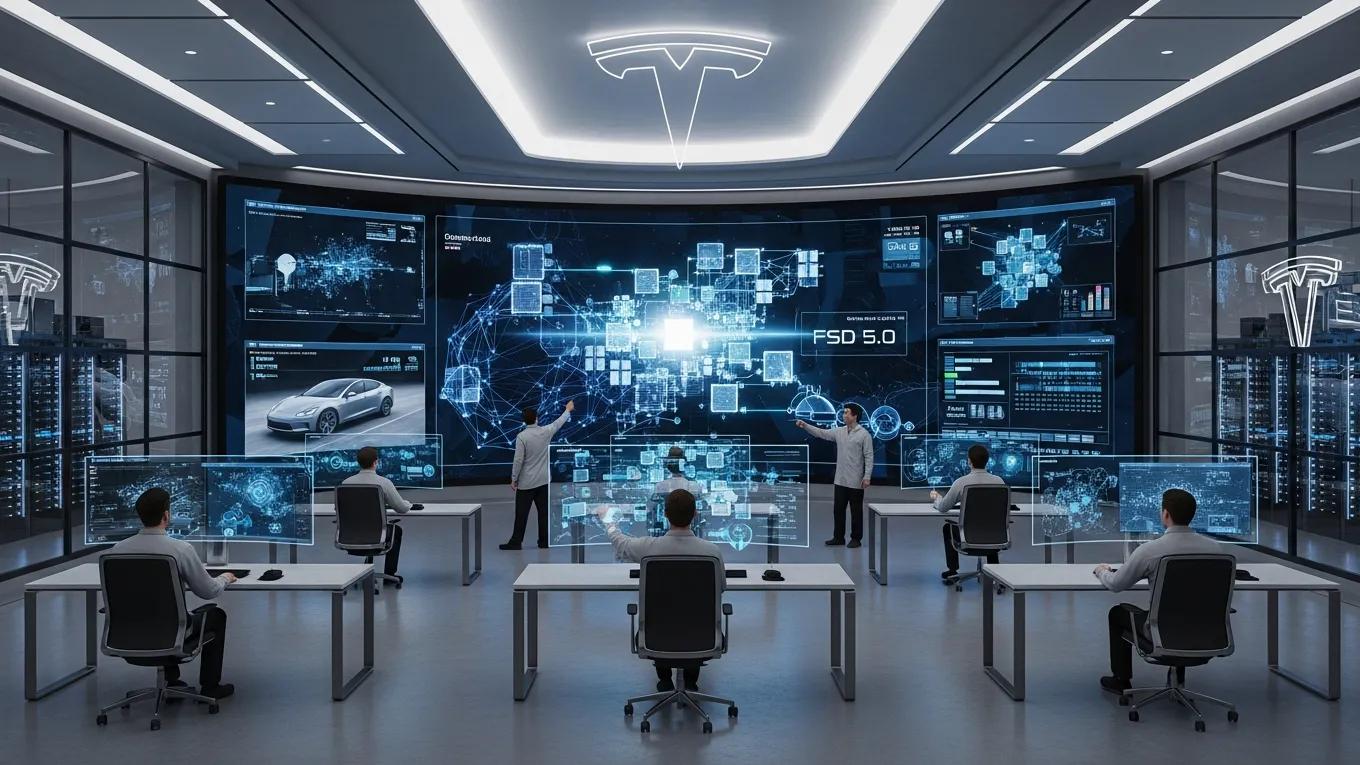
Tesla’s autonomy architecture is centered on Tesla Vision, a camera-based perception system. This system feeds neural networks, which are trained at scale using Dojo and fleet data, to generate driving models. Tesla Vision utilizes an array of cameras and a perception pipeline that processes images to identify objects, track their movement, and understand the overall scene understanding. The neural networks then translate these perceptions into control decisions. Dojo, Tesla’s custom-built supercomputer, accelerates the training of these large-scale models by processing billions of miles of anonymized driving data. The synergy between Tesla Vision, neural networks, Dojo, and fleet learning creates a continuous feedback loop—vision → neural nets → control—where large-scale training enhances the system’s ability to generalize across various driving conditions.
This sophisticated AI stack forms the backbone of Tesla’s self-driving approach. Continuous learning and data integration enable adaptive and improving driving models.
Key elements of the AI stack include:
- Tesla Vision: A camera-based perception system that prioritizes visual sensors for detecting objects and achieving scene understanding.
- Neural Networks: Deep learning models that translate perceived information into trajectory planning and control commands.
- Dojo Supercomputer: The infrastructure for model training, significantly speeding up development by utilizing fleet data.
The following table clarifies the relationship between these components and their contributions to autonomous driving.
This table illustrates how each AI component plays a specific role in achieving Tesla’s autonomous driving capabilities. The integration of perception, learning, and control is essential to system performance.
Tesla Vision: Camera-Based Perception System
Tesla Vision relies on a camera system as its primary sensor suite, using image-based neural networks instead of LiDAR for environmental perception. The perception pipeline processes data from cameras through neural networks to generate control outputs, with intermediate steps like object detection, segmentation, and tracking feeding into planning modules. A key advantage of this vision-first approach is its lower sensor cost and the availability of high-resolution visual detail, which simplifies global deployment. However, it demands highly robust models to effectively handle challenging conditions like low light, glare, and occlusions. While some may question the sufficiency of vision alone, extensive fleet-scale training and advanced neural networks help mitigate many edge cases. This approach is fundamentally dependent on vast amounts of data and continuous improvement cycles. The vision-first strategy is central to Tesla’s overall autonomy philosophy.
Relying exclusively on vision sensors requires overcoming significant technical challenges but offers scalability and cost benefits. Continuous AI refinement is necessary to maintain safety and effectiveness.
Ongoing research explores complementary methods, such as vision-language planning, to enhance scene understanding and address less common driving scenarios.
Vision-Language Planning for Autonomous Driving & Scene Understanding
ABSTRACT: Autonomous driving is a complex and challenging task that aims at safe motion planning through scene understanding and reasoning. While vision-only autonomous driving methods have recently achieved notable performance through enhanced scene understanding several key issues including lack of reasoning low generalization performance and long-tail scenarios still need to be addressed. In this paper we present VLP a novel Vision-Language-Planning framework that exploits language models to bridge the gap between linguistic understanding and autonomous driving. VLP enhances autonomous driving systems by strengthening both the source memory foundation and the self-driving car’s contextual understanding. VLP achieves state-of-the-art end-to-end planning performance on the challenging NuScenes dataset by achieving 35.9% and 60.5% reduction in terms of average L2 error and collision rates respectively compared to the previous best method. Moreover VLP shows improved performance in challenging lo
Vlp: Vision language planning for autonomous driving, B Yaman, 2024
Dojo Training and Fleet Data
Dojo functions as Tesla’s specialized supercomputer for model training, facilitating large-batch, high-throughput training sessions that accelerate the development cycle. Training on fleet data—encompassing billions of miles of anonymized real-world driving data—exposes the AI models to a wide array of conditions, including rare events and edge cases, which is crucial for developing robust performance. Dojo-trained models are then packaged and distributed to vehicles through Over-the-Air updates, creating a seamless cycle of improvement that connects large-scale computation with real-world driving performance. This extensive scale of training and deployment is a key differentiator for systems that rely on deep learning to tackle complex driving challenges.
Dojo and fleet data create a powerful feedback loop that continuously advances Tesla’s AI capabilities. This deep learning infrastructure supports ongoing improvements delivered directly to vehicles.
These technical explanations provide a foundation for the subsequent discussions on regulation and safety.
Safety, Regulation, and Roadmap to Autonomy
Safety considerations and regulatory frameworks dictate the deployment of autonomous driving technology. SAE Levels categorize capabilities, regulatory bodies grant approvals, and objective safety metrics guide adoption. SAE International provides the definitive taxonomy for automation levels. As of early 2024, Mercedes-Benz DRIVE PILOT is the only Level 3 system approved for limited use in the US, highlighting the stringent nature of regulatory approvals. The market landscape is significant: the global autonomous vehicle market was valued at USD 364.08 billion in 2026, with the autonomous driving software market projected at USD 2.36 billion in the same year. North America is expected to command a 29.3 percent share of the autonomous vehicle market by 2026. These figures underscore both the market potential and the regulatory oversight applied to higher levels of automation.
Regulatory and market factors strongly influence the pace and scope of autonomous driving deployment. Approval hurdles and economic scale shape industry dynamics and technology introduction.
Safety projections and market statistics offer insights into public health impact and economic scale: autonomous systems are anticipated to prevent approximately 490 deaths, 8,800 injuries, and 23,000 crashes annually by 2035. Sales of autonomous vehicles are projected to reach around 14.97 million units in 2026, with an estimated 42,770 autonomous vehicles operating globally in 2026. Autonomous trucking currently supports an estimated 17,000 jobs and generates approximately USD 3.3 billion in US economic output as of early 2024. These statistics emphasize that advancements in AI and machine learning are vital for achieving higher levels of autonomy—and that Level 2 systems currently lead the autonomous driving software market, while higher levels face significant technical and regulatory hurdles.
The societal and economic impacts of autonomous driving are profound, with potential for substantial safety improvements and job creation. However, widespread adoption remains conditional on technological and regulatory progress.
To present safety data clearly, the table below lists key metrics and their sources:
Accurate data visualization supports understanding of the broad landscape influencing autonomous vehicle adoption. Tracking these metrics aids stakeholders in decision-making and policy development.
Safety Data, SAE Levels, and Driver Supervision
Empirical safety data and the definitions of SAE Levels explain why driver supervision remains a requirement for current systems; SAE Levels provide a structured framework, and driver monitoring systems help mitigate misuse. Projected safety improvements highlight the potential benefits of widespread adoption, while driver monitoring systems and human factors engineering address the practical need for sustained driver attention in Level 2 and supervised FSD systems. Recent regulatory approvals and the limited deployment of Level 3 systems (such as Mercedes-Benz DRIVE PILOT) illustrate that achieving higher levels of autonomy requires both robust technical validation and clear legal pathways. Acknowledging these constraints is crucial for setting realistic timelines and safety expectations.
Maintaining rigorous driver supervision mitigates risks and supports safer adoption of current ADAS technologies. Regulatory milestones set benchmarks for future advancements in autonomy.
Future Roadmap and Higher Autonomy Levels
Advancing to Level 3, Level 4, and Level 5 autonomy hinges on significant progress in robust perception capabilities, validated prediction and planning algorithms that handle diverse edge cases, and regulatory approvals tied to specific operational design domains (ODDs). Key technical milestones include enhancing generalization across different environments, conducting exhaustive safety validation for rare events, and providing transparent validation data that satisfies both regulators and consumers. Timelines for these advancements remain uncertain; while progress in AI and machine learning is essential, regulatory hurdles and the complexities of real-world edge-case handling introduce variability. A pragmatic roadmap emphasizes gradual progress, continuous fleet learning, and alignment with regional regulatory frameworks before widespread deployment of Level 3 and higher systems.
The path toward full autonomy is complex and contingent on interdisciplinary achievements. Strategic incremental improvements and stakeholder collaboration are vital for success.
These discussions on safety and future roadmaps naturally lead into how software improvements are delivered to owners via OTA updates and how these updates relate to subscription models.
OTA Updates, Pricing, and the Tesla AI Experience
Over-the-Air updates facilitate the continuous delivery of new features, safety patches, and model enhancements directly to vehicles, eliminating the need for physical service visits and closing the loop between Dojo training outcomes and in-car performance. FSD subscriptions offer owners flexible access to Full Self-Driving (Supervised) features, either as a recurring service or as an alternative to a one-time purchase. Account management tools allow owners to manage these features through their vehicle or account settings. The AI interface within the vehicle displays system status, suggested maneuvers, and environmental visualizations on the Autopilot screen, integrating confirmations and driver attention cues into the vehicle interior. Collectively, OTA updates, subscriptions, and the in-car UX define the Tesla AI experience by continually refining AI models and delivering enhancements directly to the vehicles.
The integration of over-the-air delivery and subscription management simplifies user access to evolving AI capabilities. This seamless process enhances vehicle functionality and user control.
Owners should be aware of these practical aspects regarding OTA updates and subscriptions:
- Over-the-Air Updates: Deliver new features and safety improvements remotely, enabling rapid deployment of Dojo-trained model improvements.
- FSD Subscriptions: Provide time-limited access to Full Self-Driving (Supervised) features as an alternative to a one-time purchase.
- In-Car UX: The autopilot screen visualizes the driving environment and provides alerts to support supervised autonomy.
Understanding update mechanisms and subscription options empowers owners to optimize their use of Tesla’s autonomous driving technologies. This transparency supports informed decisions and ongoing safety.
Over-the-Air Updates and FSD Subscriptions
Over-the-Air updates translate Dojo-trained models into vehicle software, allowing Tesla to continuously refine perception and control systems without requiring hardware recalls. For owners, OTA delivery typically appears as a software notification, offering options to schedule the installation. FSD subscription management is handled through the owner’s account, allowing activation or deactivation based on preference. Because OTA updates link model improvements derived from fleet data, owners benefit from iterative performance gains as Dojo accelerates training cycles. Owners should verify their update settings and subscription status in their account or vehicle interface to stay current with feature rollouts and safety updates.
Proactive management of software updates and subscriptions is recommended to maximize safety and feature benefits. Ongoing Dojo training ensures continuous model refinement reflected in OTA updates.
Interior Experience and User Interactions in Autonomous Driving
The Autopilot screen presents the AI driving system’s perception of the environment—including lane lines, surrounding vehicles, and intended trajectories—allowing drivers to monitor system decisions and remain engaged. User interactions involve confirmation prompts for complex maneuvers, visual and auditory alerts to ensure driver attention, and streamlined route guidance when higher-level features are active. The vehicle interior is increasingly designed to facilitate clear communication between the system and the supervising human, with visualizations intended to minimize ambiguity and enhance situational awareness. As autonomous technology matures, interior design concepts will adapt to support supervised operation and, within approved operational domains, to allow for more permissive driver disengagement models.
Visual and interactive feedback within the vehicle strengthens driver awareness and control during supervised autonomous driving. Future interior innovations will further align user experience with system capabilities.
These user experience and delivery topics lead into practical next steps and recommendations for readers interested in Tesla products, careers, or support.
Call to Action
For readers interested in exploring Tesla, Inc.’s vehicles and offerings, Tesla, Inc. is a premier electric vehicle and clean energy company. tesla.com serves as the central hub for product details, sales, customer support, and recruitment. When considering options, it’s important to weigh the benefits of Autopilot’s Level 2 safety assists against the advanced features of Full Self-Driving (Supervised), and to review the subscription versus one-time purchase options available through vehicle account settings. Owners should ensure their Over-the-Air update settings are configured correctly and manage their subscription status to receive Dojo-trained model improvements and feature updates. Individuals interested in contributing to this technological ecosystem can find career opportunities and hiring information on Tesla’s main platform and support channels.
- Explore vehicle features: Compare Autopilot and FSD capabilities to determine which best suits your driving needs.
- Manage subscriptions and updates: Utilize your account and vehicle settings to enable OTA installations and manage FSD access.
- Understand safety responsibilities: Remember that all Level 2 systems require constant driver supervision.
Engaging with Tesla’s ecosystem involves careful consideration of technology, safety, and personal preferences. Informed users contribute to safer and more satisfying driving experiences.
This final table summarizes the relationship among Tesla’s public platform, OTA delivery, and the Full Self-Driving product classification, using the factual terminology presented throughout this guide.
Clear articulation of roles and classification supports user understanding and informed engagement with Tesla technologies and services.
Frequently Asked Questions
What are the limitations of Tesla’s Autopilot and Full Self-Driving features?
Tesla’s Autopilot and Full Self-Driving (FSD) features are classified as SAE Level 2 automation, which means they require constant driver supervision. While these systems can assist with tasks like lane keeping and adaptive cruise control, they are not fully autonomous. Limitations include the inability to handle complex urban environments without driver intervention, reliance on clear lane markings, and performance degradation in adverse weather conditions. Understanding these limitations is crucial for safe operation and setting realistic expectations for users.
Users must remain engaged and attentive to compensate for system boundaries. Awareness of these factors is vital to operational safety.
How does Tesla’s Dojo supercomputer enhance Autopilot capabilities?
Dojo is Tesla’s custom-built supercomputer designed to accelerate the training of neural networks that power Autopilot and FSD features. By processing vast amounts of anonymized driving data collected from Tesla vehicles, Dojo enables rapid model training and improvement. This continuous learning process allows Tesla to refine its AI algorithms, enhancing the vehicle’s ability to interpret complex driving scenarios and improve overall performance. The integration of Dojo into Tesla’s AI stack is a key factor in the ongoing evolution of its autonomous driving capabilities.
Dojo’s computational power is a cornerstone of Tesla’s AI improvement strategy, linking data and software to in-car functionality. Continuous training keeps the system state-of-the-art.
What is the role of Over-the-Air updates in Tesla’s Autopilot system?
Over-the-Air (OTA) updates play a vital role in Tesla’s Autopilot system by allowing the company to deliver new features, safety enhancements, and performance improvements directly to vehicles without requiring physical service visits. These updates ensure that all Tesla vehicles benefit from the latest advancements in AI and driving technology, as they can receive updates based on the latest training from the Dojo supercomputer. This capability not only enhances the driving experience but also helps maintain safety standards across the fleet.
OTA updates bridge the gap between AI development and vehicle operation. They enable rapid and widespread deployment of improvements to enhance safety and functionality.
How does Tesla ensure safety in its Autopilot and FSD systems?
Tesla prioritizes safety in its Autopilot and Full Self-Driving systems through a combination of rigorous testing, continuous data collection, and adherence to regulatory standards. The systems are designed to require constant driver supervision, which mitigates risks associated with automation. Additionally, Tesla analyzes billions of miles of driving data to identify potential safety issues and improve system performance. The company also collaborates with regulatory bodies to ensure compliance with safety regulations, further enhancing the reliability of its autonomous driving technologies.
Safety is a multi-faceted process combining technology, supervision, and governance. Tesla’s approach balances innovative features with necessary control measures to protect users.
What are the differences between purchasing and subscribing to Full Self-Driving?
When it comes to accessing Full Self-Driving (FSD) features, Tesla offers two options: a one-time purchase or a subscription model. The one-time purchase provides lifetime access to FSD capabilities, while the subscription allows for flexible, time-limited access to the same features. This subscription model can be beneficial for users who may not want to commit to a full purchase upfront or who prefer to pay for the service as needed. Both options ensure that users can benefit from ongoing updates and improvements to the FSD system.
These purchasing options cater to diverse user preferences and financial considerations. Both provide access to the same evolving feature set.
What should drivers know about the supervision requirements for Autopilot?
Drivers using Tesla’s Autopilot and Full Self-Driving features must understand that these systems are classified as Level 2 automation, which mandates continuous human supervision. This means that drivers must keep their hands on the wheel, remain attentive to the road, and be prepared to take control at any moment. The systems are designed to assist rather than replace human drivers, and failing to maintain proper supervision can lead to safety risks. Understanding these requirements is essential for safe and effective use of Tesla’s advanced driving technologies.
Safe use depends fundamentally on driver alertness and readiness to intervene. These systems do not replace the human driver but serve as supplemental aids.
Conclusion
Tesla’s Autopilot and Full Self-Driving systems represent significant advancements in driver assistance technology, enhancing safety and convenience on the road. By leveraging AI and continuous learning from fleet data, these systems offer drivers a unique blend of support and autonomy while maintaining essential supervision requirements. Exploring the features and options available can help you make informed decisions about your driving experience. Visit Tesla’s website today to discover more about how these innovations can transform your journey.
These technologies are reshaping driving through innovation and evolving AI capabilities. Staying informed ensures safer and more satisfying use of Tesla’s autonomous driving systems.